
Post-genocide Rwanda: between modernisation, international influence, and authoritarian drift
By Martin Grandrie
Translated by Mathilde Varboki, Lou Steins, Fatima Dubois and Mila Issolah
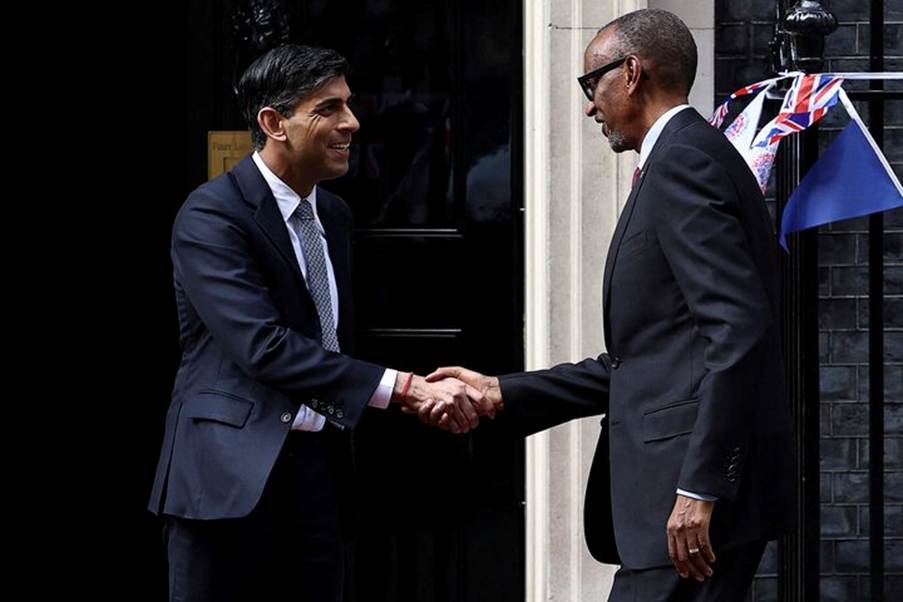
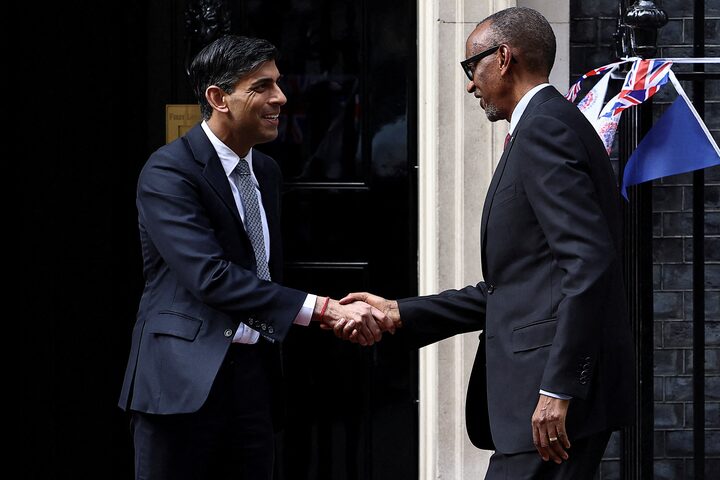
British Prime Minister Rishi Sunak shakes hands with Rwandan President Paul Kagame at Downing Street in London on May 4, 2023. REUTERS/Henry Nicholls
Long associated with the 1994 genocide, Rwanda has since thoroughly rebuilt and modernised itself under the presidency of Paul Kagame, and established itself as a key economic actor in Africa. Through a strategy of raising its international profile, illustrated by the hosting of the 2025 UCI Road World Championships, Rwanda seeks to redefine its image and strengthen its presence on the global stage. This article will explore the tools Paul Kagame has used to achieve this ambitious strategy.
Bugesera International Airport is a gigantic facility which combines the refined silhouette of its innovative design with operational efficiency. This architectural gem was designed to project a dynamic and modern image of the country, as well as to serve as a major regional hub. The construction of this new international airport, located at approximately one hour and fifteen minutes from the capital, Kigali, began in 2017. The first phase, expected to be completed between 2027 and 2028, will enable the airport to handle up to seven million passengers a year. A second phase, set to be finished in 2032, will double that capacity to 14 million. The Bugesera airport will also feature a freight terminal capable of managing up to 150,000 tonnes annually.
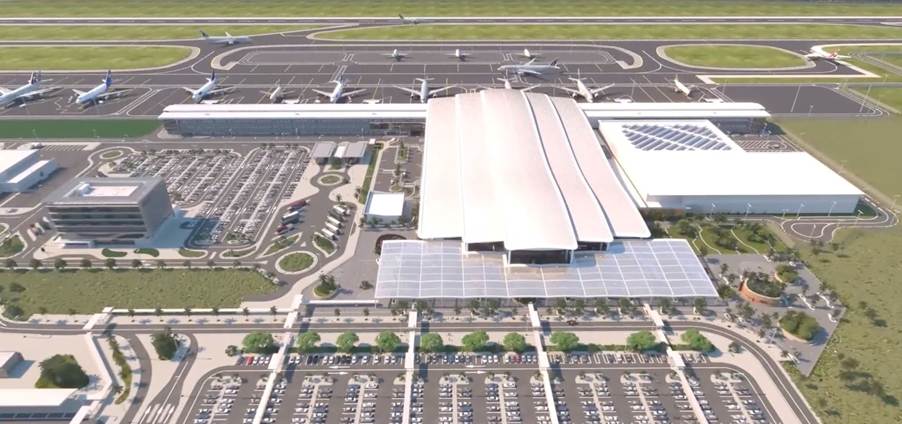
Bugesera Airport (Aviation Travel and Logistics)
This image of modernity sharply contrasts with that of the Tutsi genocide, which occurred between April 7th and July 17th, 1994: a dark chapter of Rwandan history, marked by an outbreak of unprecedented violence that left behind a devastated nation and a staggering death toll of around 800,000. Thirty-one years after the genocide, Rwanda, led by Paul Kagame since 2000, seems to have risen from the ashes, almost miraculously so according to some researchers1. With 1.4 million tourists in 2023 and a growth rate approaching 9% according to the World Bank, the country has emerged as a true economic leader in the region, thanks to proactive investment and modernisation policies. On the global stage, the government has made no secret of its ambitions, multiplying its strategic partnerships and hosting world-class events, such as the UCI Road World Championships that will take place around Kigali from September 21st to September 28th, a historic first for the African continent. These measures are all part of a regional and international influence strategy pursued for several years by Paul Kagame, aimed at improving Rwanda’s image, strengthening its economic and tourist appeal, and expanding its diplomatic influence. This process relies on the concept of soft power, coined in the 1990s by American political scientist Joseph Nye2. Unlike hard power, based on coercion, soft power is the ability to seduce and attract3. In other words, it refers to an actor’s ability to influence others through appeal and persuasion rather than coercion or payment. Le Monde, in an article published on April 5th, 2024, summarises: “Thanks to investments and imagination, Rwanda, a tiny enclave in Central Africa, has, in about ten years, managed to build a global brand image out of all proportion to its size”4.
Yet Rwanda stands accused by the United Nations of supporting the M23 armed movement amid the long-standing conflict in the Democratic Republic of Congo (DRC), which has reignited since 2021. Such accusations could tarnish the image of a safe and respectable country that Paul Kagame has worked tirelessly to build over many years. This article therefore seeks to analyse the instruments that have been used to implement this ambition of international influence, and to assess the potential consequences of Rwanda’s involvement alongside M23 in the Democratic Republic of Congo on the credibility of its soft power. It will first explore the economic and political levers used by Rwanda, before considering how the country relies on soft power to shape its image as a dynamic, stable, clean and modern nation. Finally, this analysis will be nuanced by turning to the contradictions of the Rwandan model.
Economic and political levers
The first lever used by Paul Kagame to rebuild and develop Rwanda is the economic one. The Rwandan president wishes to equip the country with an efficient and appealing economy, reflected in the Vision 2020 and Vision 2050 plans. Launched in 2000, the Vision 2020 programme sought to transform Rwanda into a united, democratic, competitive middle-income nation. The plan rested on several pillars: good governance and an efficient state, skilled human capital, a dynamic private sector, world-class infrastructure, and modernised agriculture and livestock farming. The Vision 2050 programme5, for its part, aims to continue the country’s modernisation by building on the successes of the Vision 2020 plan, while addressing its shortcomings. Through it, Paul Kagame reaffirms his ambition of turning Rwanda into an upper-middle-income economy by 2035, then a high-income economy by 2050. It is noteworthy that these two plans testify to the Rwandan president’s desire to raise the country’s profile internationally, as they explicitly form part of a global agenda and align with major international policy initiatives, such as the Sustainable Development Goals, the African Union’s Agenda 2063, the East African Community’s Vision 2050, and the Paris Agreements on climate change.
Paul Kagame has also implemented effective reforms in the fight against corruption. Rwanda is a regional leader in this regard, ranking as the 43rd least corrupt country out of 180 in Transparency International’s 2024 Corruption Perceptions Index. With a score of 57 out of 100, it stands ahead of countries such as Spain, Italy, and Poland. On a regional scale, it is the third least corrupt country in Africa6. Additionally, political stability (Paul Kagame has been president since 2000) reinforces Rwanda’s economic stability. As observed by Jérémy Révillion, an associate researcher at the Les Afriques dans le Monde (LAM) research centre: “Rwanda is considered by many as the ideal place to develop a business. […] The country is perceived as an economic model by international donors”7. For instance, the Doing Business index, which ranks economies by their ease of doing business, places Rwanda 38th worldwide, and second in Africa, behind Mauritius8. This good economic health has also led to a redistribution of growth, as indicated by Jérémy Révillon: “the country’s economic performance actually generates an improvement in the living standards of its inhabitants” (Révillon, 2014). Indeed, the national poverty rate fell from 59.2% in 2000 to 47.4% in 2022, according to the World Bank, while life expectancy rose by 20 years to reach 67.1 years in 2022, and the infant and maternal mortality rates have been cut fivefold.
Nonetheless, this analysis warrants some qualification. For all its reputation as a regional economic leader, Rwanda’s situation remains mixed, as shown by a UN report released on May 30th, 2025. According to Olivier De Schutter, the UN Special Rapporteur, although poverty has fallen (from 39.8% in 2018 to 27.4% in 2024), economic inequality persists. The expert also points to the rising public debt as a cause for concern, which now exceeds 78% of GDP9. Additionally, Rwanda’s Human Development Index remains very low, standing at 0.548 in 2022, which put the country 162nd out of 193 countries10. Moreover, the country suffers from a dependence on international aid as explained by the newspaper Le Monde in an article published on February 19th, 2025: “In total, Rwanda receives around 1.3 billion dollars in international aid, a substantial income given that its latest annual budgets have hovered around 4 billion dollars”11. Rwanda’s president himself acknowledged this dependency, declaring in a speech on October 4th, 2012: “Foreign aid is a poison, we must learn to do without it…” (Révillon, 2014). Rwanda faces another structural limit: its landlocked status. Rwanda is located in the African Great Lakes region and lacks any access to the sea, which causes significant issues for its economy, as underlined by the researcher Jérémy Révillon: “40% of costs stem from transport between Mombasa (Kenya), the main entry port for Rwandan goods, and Kigali, the Rwandan capital. This extreme dependence regarding the Kenyan port often penalises the country, especially because of delays in the delivery of goods” (Révillon, 2014).

Rwanda, a landlocked country bordered by the Democratic Republic of Congo, Uganda, Burundi, and Tanzania. (Universalis)
Finally, beyond its dependence on international aid, Rwanda remains vulnerable to fluctuations in commodity markets, particularly coffee, the country’s fourth-largest export. According to the National Agricultural Export Development Board (NAEB), in 2022 Rwanda exported 24,000 tonnes of coffee worth more than 108 billion Rwandan francs (the official currency). This situation, however, is far from a recent phenomenon, as noted by Jérémy Révillon: “Rwanda was hit hard by the collapse in coffee prices in the beginning of the 1990s (a 50% drop in international coffee exports during the summer of 1989), causing export revenues to plunge from 144 million dollars in 1985 to 30 million in 1993” (Révillon, 2014).
Nevertheless, over the years Rwanda has succeeded in building an economy that, despite persistent challenges, demonstrates sustained dynamism and continues to modernise, earning the trust of international donors. This economic foundation serves as a crucial lever on which Paul Kagame can rely to strengthen the country’s influence on the global stage. Yet the Rwandan president does not wish to stop there. To expand Rwanda’s influence, he has signed several bilateral agreements in recent years with major actors of the international community. One example is the migration deal signed in 2022 with the United Kingdom12 arranging for the transfer of asylum seekers that illegally entered the United Kingdom to Rwanda, a “safe” third country, which would then process their asylum applications and either approve or reject them. For London, the aim was to combat illegal immigration and dissuade people from crossing the Channel by boat. In exchange, Rwanda was to receive 240 million pounds13. The project was ultimately declared unlawful by the UK Supreme Court in November 2023. With the arrival of Keir Starmer as prime minister on July 5th, 2024, the project was definitively abandoned. Even so, this episode illustrates Rwanda’s willingness to affirm itself as a responsible actor on the international stage.
However, in order to overcome the image of a country on the brink of collapse after a genocide that claimed 800,000 lives in 100 days, Paul Kagame has also had to turn to various levers of soft power to burnish the country’s image.
Tourism and sport: complementary levers of Rwandan soft power
Tourism plays a central role in this strategy of raising the country’s international profile. Using tourism as a soft power tool clearly reflects Paul Kagame’s ambition to project an image of stability and modernity.
To this end, Paul Kagame relies on the official Visit Rwanda brand, launched in 2018 by the Rwanda Development Board. Its goal is to make Rwanda known internationally and to attract tourists and investors. It does so by promoting the country’s natural wealth, as illustrated by the official website’s homepage, which introduces Rwanda as follows: “Known as the land of a thousand hills, Rwanda’s stunning scenery and warm, friendly people offer unique experiences in one of the most remarkable countries in the world. It is blessed with extraordinary biodiversity, with incredible wildlife living throughout its volcanoes, montane rainforest and sweeping plains”14. Rwanda has several natural assets such as Lake Kivu (2,700 km², the sixth largest lake in Africa), the Akagera National Park (2,500 km²), as well as the Volcanoes National Park, which serves as an observation centre and a site for photography safaris dedicated to mountain gorillas, an endemic species that has become a must-see attraction for tourists.
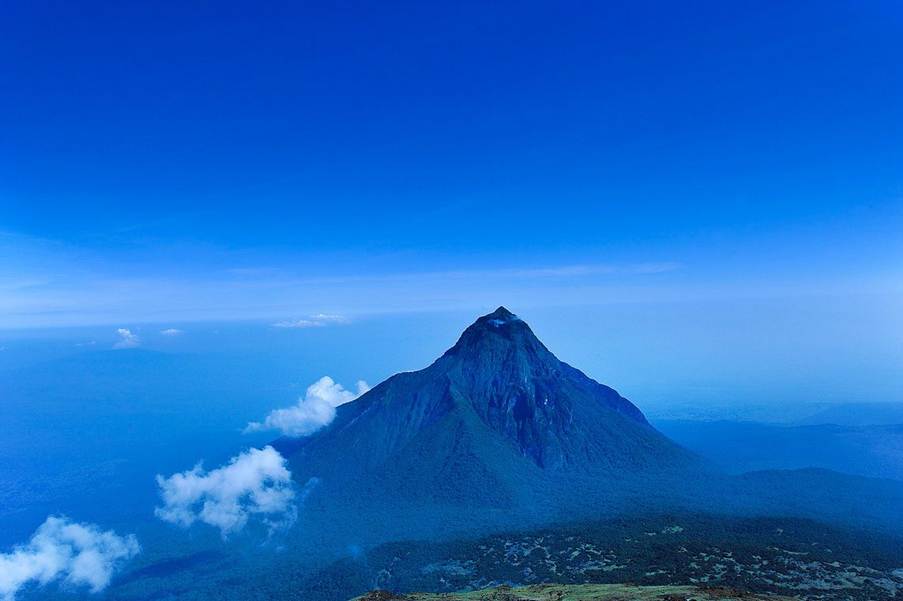
Volcanoes National Park (Visit Rwanda website)
Tourism also allows Paul Kagame to promote the image of a clean and well-ordered country, as explained by economist Thierry Amougou: “Kigali today stands as a showcase of modern functionality and aesthetics, with flawless public hygiene, that never fails to impress visitors to the capital of the thousand hills”15. Moreover, to amplify the reach of this tourism-driven diplomacy, the Visit Rwanda brand has forged partnerships with several major European football clubs, such as Paris Saint-Germain, Arsenal, Bayern Munich, and Atlético Madrid16. These examples illustrate a point of convergence between two of Rwanda’s key soft power levers: tourism and sport.
Rwanda is a regional leader in sport, especially in cycling. Since 1988, Rwanda has hosted its own national tour, now part of the UCI Africa Tour (a race circuit organised by the Union Cycliste Internationale for the African continent). In recent years, the event has grown in popularity, attracting major international teams such as Israel-Premier Tech, Total Energies, and Lotto Dstny. In this respect, it is interesting to note that the last two winners in the general ranking have been European: Britain’s Joseph Blackmore in 2024, and France’s Fabien Doubey in 2025. The Tour du Rwanda is the product of deliberate policy by Paul Kagame, given that, according to the newspaper Le Soir, 40% of the race’s funding comes from the public sector17.

Paul Kagame alongside David Lappartient, president of the UCI, at the start of the 2025 Tour du Rwanda. (L’Equipe, February 23rd, 2025)
This ambitious strategy has borne fruit, with Rwanda winning the bid to host the Cycling World Championships in September 2025, a historic first for the African continent. For Rwanda, the benefits of hosting such an event are manifold: beyond the economic opportunities for the hospitality, transport, and tourism sectors, the route, which loops around the capital Kigali, will promote Rwandan landscapes, attracting new tourists. As explained by former Olympic swimmer Samson Ndayishimiye in an article from Le Monde, published on July 7th, 2024: “Hosting World Championships is an enormous reward for a small country. The Visit Rwanda brand already brings visitors from all around the world, so why not draw in more through cycling”18.
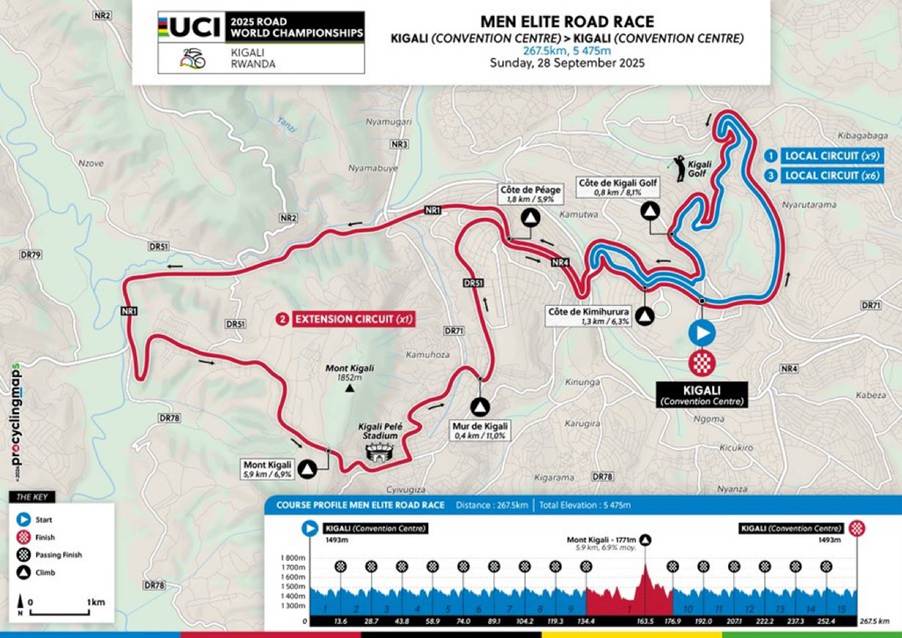
Route of the World Cycling Championships around the Rwandan capital Kigali. (UCI)
Cycling thus enables Paul Kagame to extend and complement his tourism diplomacy in order to promote the image of a stable, modern, and dynamic country. However, his plans for Rwandan international influence run into several limits and contradictions.
The Contradictions of Rwanda’s model
While Rwanda strives to portray itself as a stable, modern, and attractive state through its soft power strategy, this image is undermined by several contradictions, both internal and external.
First of all, Rwanda’s economic performance and its administration’s record of good governance are often met with criticisms from NGOs denouncing authoritarian abuses. In 2015, Paul Kagame amended the constitution, allowing him to run for office until 2034. The Rwandan president is also accused of wanting to silence political opponents by the NGO Human Rights Watch in their 2025 report: “The authorities’ crackdown on the opposition, media, and civil society persisted ahead of general elections which took place on July 15th, 2024. Rwandans were not able to freely express their views and exercise their vote fairly and peacefully. At least fourteen members of the unregistered Dalfa-Umurinzi opposition party and four journalists and critics are behind bars”19. The most recent example is the arrest of Victoire Ingabire on June 19th, 2025, who faces charges of “criminal conspiracy” and “inciting the masses to revolt against the government”.
Furthermore, on a regional scale, Rwanda’s involvement alongside M23 in the conflict in the DRC risks tarnishing its image, compromising diplomatic relations and, by extension, weakening its bid for international influence. Although Rwanda denies these allegations, a UN expert report published in July 2024 estimated that around 4,000 soldiers from the Rwandan forces had been deployed in eastern DRC20. Rwandan goals in the DRC are multifaceted: to protect its security and economic interests in the border area of North Kivu; to maintain strategic influence in this region rich in mineral resources; and to neutralise the Democratic Forces for the Liberation of Rwanda (FDLR), a DRC-based Hutu armed group hostile to the Kigali regime. In this context, it is worth recalling that Paul Kagame is himself of the Tutsi ethnic group and a former commander in the Front Patriotique Rwandais (Rwandan Patriotic Front), the rebel armed group which brought an end to the genocide of the Tutsi in July 1994.
Nevertheless, beyond these factors of hard power, the involvement of Rwanda in the DRC stands somewhat in contrast with the soft power strategy developed by the country over the past few years. This contradiction has produced several negative consequences.
Firstly, it has resulted in diplomatic isolation for Rwanda. Several countries like Canada, the United Kingdom, or Germany announced they were suspending international aid to the country. Additionally, Rwanda’s position and its tensions with the DRC prompted Kigali to withdraw from the Economic Community of Central African States (ECCAS) on June 7th. The government in Kigali deplored the “instrumentalisation of the ECCAS by the DRC, with the support of certain member states”21.
The second consequence is the deterioration of the country’s perceived stability, with potentially negative repercussions on its attractiveness for investors. This is what journalist Christophe Châtelot explains in an article published in Le Monde on April 5th, 2024: “Is it reasonable to invest in Kigali, the glittering showcase of a nation undergoing transformation, and to visit the country, a little-known gem of a thousand hills, when, on the other side of the border, M23, a Congolese rebel group backed by Rwanda, is driving hundreds of thousands of people to take to the roads of the North Kivu province?”22.
Finally, and more generally, such a situation could gravely compromise Paul Kagame’s ambition to raise Rwanda’s international profile by fuelling calls to boycott the country, notably in sports. The aforementioned Visit Rwanda brand, for example, has now become a source of controversy. For instance, a petition entitled Stop au partenariat de la honte « PSG x Visit Rwanda » (Stop the shameful partnership between PSG and Visit Rwanda) saw the light of day at the beginning of this year, explaining that “Although this partnership was conceived in the spirit of promoting tourism, […] it is now incompatible with the values of solidarity, respect for human rights, and peace that Paris Saint-Germain embodies”23. The petition gathered around 80,000 signatures. In the world of cycling, the repercussions could also be detrimental to Rwanda. Last February, a European Parliament resolution called for the cancellation of the Road World Championships scheduled for late September “should Rwanda fail to alter its stance”24. The Belgian team Soudal-Quick-Step had already declined to participate in the Tour of Rwanda held from February 23rd to March 2nd, 2025, mainly for security reasons. The route comes close to the border with the DRC during the start of the fourth stage in Rubavu, just fifteen kilometres from Goma, a city that fell into the hands of M23 at the end of January. Despite this, government spokesperson Yolande Makolo told Agence France-Presse (AFP) in mid-February that “Rwanda is a safe destination for cyclists and visitors, and preparations for the World Championships are continuing”25. On his part, Union Cycliste Internationale president David Lappartient declared that “very clearly, conditions are met for these World Championships to take place”26.
However, a major turning point occurred on Friday, June 27th, in Washington, with the signing of a peace agreement between the DRC and Rwanda, mediated by the United States. This agreement is particularly ambitious as it aims to end the conflict that has been raging in the DRC since the late 1990s. First, it sets out provisions on “respect for territorial integrity and the cessation of hostilities” in eastern DRC, as well as provisions on “withdrawal, disarmament, and conditional integration of non-state armed groups”. For Rwandan Foreign Minister Olivier Nduhungirehe, the agreement is based on “the commitment made here to put an irreversible and verifiable end to [the Congolese] state’s support for the FDLR and associated militias”27. Moreover, this deal seeks to replace the logic of confrontation with one of co-development, drawing on the economic interdependency between the DRC and Rwanda. Finally, it provides for the establishment of a Joint Security Coordination Mechanism incorporating the Concept of Operations (CONOPS) inherited from the agreements of October 31st, 2024. This will involve, for example, direct cooperation between Congolese and Rwandan armed forces to monitor the border, disarm militias, and secure areas28.
The agreement signed on June 27th offers hope for effective peace in the region. While numerous ceasefires since 2021 have been broken, this new accord could be different. As Thierry Vircoulon, associate researcher at the Africa Centre of the French Institute of International Relations (Ifri), explains: « What fundamentally changes today is Washington’s involvement, which was not there before, and which has taken charge of these negotiations and holds sway over both capitals. The United States is one of the few countries with what is known as ‘convening power’, the ability to bring Kigali and Kinshasa to the same table”29. For Donald Trump, the interests are twofold. The deal will allow him to better control the Congolese mining sector, and thus to compete with China’s presence in the region. At the same time, it offers the US President the opportunity to cast himself as a peacemaker, as this statement of his demonstrates: “Today, violence and destruction come to an end, and the entire region begins a new chapter of hope and opportunity, of harmony, prosperity, and peace”. Donald Trump thus finds himself in an ideal position for someone who dreams of winning the Nobel Peace Prize.
Yet while the agreement marks an important and symbolic step forward, it remains far from perfect. For one thing, it does not directly include M23. The armed group signed a separate ceasefire with the Congolese government in Doha, Qatar, on July 19th, but failed to agree on a comprehensive peace deal. Moreover, according to the NGO Physicians for Human Rights, the accord between the DRC and Rwanda contains “major omissions”, particularly regarding human rights violations30. The agreement has also proved divisive, especially within the DRC. The People’s Party for Reconstruction and Democracy (PPRD), the party of former president Joseph Kabila, has denounced the deal as unconstitutional and accused the government of giving away national resources without consulting the people. Denis Mukwege, the 2018 Nobel Peace Prize laureate, has firmly condemned the accord, accusing Kinshasa of surrendering national sovereignty and legitimising Rwandan occupation. L’Union Sacrée, the governing presidential majority, has welcomed the agreement and thanked the United States for its mediation, while lamenting the lack of enforcement mechanisms to ensure compliance31. Neither the DRC–Rwanda agreement nor the M23 ceasefire, however, has brought lasting peace. Fighting continued throughout August in the north-eastern DRC, underscoring the fragility of both deals and the stagnation of the negotiation process. For Rwanda, the accord could nonetheless serve to restore its image and revive its ambitions for international influence. Yet the lingering shadow of its alleged support for M23 risks continuing to tarnish its credibility, exposing the deep contradictions between its soft power aspirations and its regional politics.
Conclusion
Thirty-one years after a bloody genocide that followed three years of civil war between Hutu and Tutsi communities, Rwanda has succeeded in thoroughly rebuilding itself. Under the rule of Paul Kagame, in power since 2000, the country has pursued an ambitious strategy of increasing its regional and international influence. To do so, it has increasingly modernised, cultivated an attractive economy, and expanded its diplomatic reach through a web of international partnerships. Kagame has also sought to project the image of a stable, secure, and dynamic country, one that now stands as a regional economic leader and an emerging hub for tourism and sport. Yet this success story is shadowed by criticism of a regime perceived as authoritarian, as well as by Rwanda’s involvement alongside the M23 rebellion in the Democratic Republic of Congo. These factors have cast doubt on the country’s reputation and exposed the inconsistencies of its soft power strategy. Despite the recent peace accord signed between Kigali and Kinshasa, deep-rooted tensions may continue to undermine Rwanda’s image as a nation that has dealt with its violent past and now looks to the future. Against this backdrop, the World Cycling Championships scheduled for September will serve as a crucial test of Paul Kagame’s ambitions. They could act as a powerful symbol of Rwanda’s renewal, or, just as easily, lay bare its limits.
Bibliography
Amougou, T. (2021). Rwanda: ombres et lumières d’un leadership vert. Analyse Opinion Critique, (28).
Balibutsa, M. (2000). Une archéologie de la violence en Afrique des Grands Lacs. CICIBA.
Boniface, P. (2021). Géopolitique du sport. Dunod.
Hugon, P. (2016). Géopolitique de l’Afrique (4e éd.). Armand Colin.
Jacquemot, P. (2009). Ressources minérales, armes et violences dans les Kivus (RDC). Hérodote, 134(3), 73–95.
Nye, J. S. (1990). Bound to Lead: The Changing Nature of American Power. Basic Books.
Révillon, J. (2014). Le Rwanda, un modèle économique ? Les Cahiers d’Afrique de l’Est / The East African Review, 48, 51–66.
Webography
Amougou, T. (2019, October 31st). « Le modèle rwandais remet en lumière les questions sur le développement en Afrique ». Le Monde. https://www.lemonde.fr/afrique/article/2019/10/31/le-modele-rwandais-remet-en-lumiere-les-questions-sur-le-developpement-en-afrique_6017632_3212.html
Châtelot, C. (2024, April 5th). Rwanda : une renaissance sans compromis, trente ans après le génocide des Tutsi. Le Monde. https://www.lemonde.fr/afrique/article/2024/04/05/la-renaissance-sans-compromis-du-rwanda_6226169_3212.html
Courrier international. (2024, April 8th). Trente ans après le génocide. Vélo et partenariats : au Rwanda, Kagame parie sur le soft power sportif. https://www.courrierinternational.com/stories/trente-ans-apres-le-genocide-3-3-velo-et-partenariats-kagame-parie-sur-le-soft-power-sportif
Hochet-Bodin, N. (2024, July 7th). Le Rwanda dans la roue du cyclisme mondial. Le Monde. https://www.lemonde.fr/afrique/article/2024/07/07/le-rwanda-dans-la-roue-du-cyclisme-mondial_6247486_3212.html
Vircoulon, T. (2025, June 27th). Accord RDC-Rwanda à Washington : l’Amérique peut-elle réconcilier Kigali et Kinshasa ? IFRI. https://www.ifri.org/fr/presse-contenus-repris-sur-le-site/accord-rdc-rwanda-washington-lamerique-peut-elle-reconcilier
Footnotes
- Jérémy Révillon, Le Rwanda, un modèle économique ?, Les Cahiers d’Afrique de l’Est / The East African Review, 48 | 2014, 51-66. ↩︎
- Le Monde. (2025, May 9th). La mort de Joseph S. Nye, théoricien américain des relations internationales. https://www.lemonde.fr/disparitions/article/2025/05/09/la-mort-de-joseph-s-nye-theoricien-americain-des-relations-internationales_6604404_3382.html ↩︎
- Nye, Bound to Lead : The Changing Nature of American Power, New York, Basic Books, 1990. ↩︎
- Le Monde. (2024, April 5th). La renaissance sans compromis du Rwanda. https://www.lemonde.fr/afrique/article/2024/04/05/la-renaissance-sans-compromis-du-rwanda_6226169_3212.html ↩︎
- Vision 2050: Abridged Version (Republic of Rwanda — Ministry of Finance and Economic Planning), https://www.minecofin.gov.rw/fileadmin/user_upload/Minecofin/Publications/REPORTS/National_Development_Planning_and_Research/Vision_2050/English-Vision_2050_Abridged_version_WEB_Final.pdf ↩︎
- Indice de la perception de la corruption 2024 (Transparency International, PDF version, February 2025), https://transparency-france.org/wp-content/uploads/2025/02/IPC2024-1.pdf ↩︎
- Jérémy Révillon, “Le Rwanda, un modèle économique ?”, Les Cahiers d’Afrique de l’Est / The East African Review, 48 | 2014, 51-66. ↩︎
- World Bank Group, Doing Business in Rwanda, https://archive.doingbusiness.org/en/data/exploreeconomies/rwanda ↩︎
- OHCHR (Haut-Commissariat des Nations Unies aux droits de l’homme),https://www.ohchr.org/fr/press-releases/2025/05/rwanda-must-avoid-balancing-budget-backs-poor-un-poverty-expert ↩︎
- UNDP (United Nations Development Programme), UNDP Rwanda Annual Report 2022 ↩︎
- Le Monde. (2025, February 19th). Le Rwanda suspend l’aide au développement de la Belgique, accusée de prendre parti pour la RDC. https://www.lemonde.fr/afrique/article/2025/02/19/le-rwanda-suspend-l-aide-au-developpement-de-la-belgique-accusee-de-prendre-parti-pour-la-rdc_6553802_3212.html#:~:text=Au%20total%2C%20le%20Rwanda%20per%C3%A7oit,les%204%20milliards%20de%20dollars ↩︎
- Government of the United Kingdom, Memorandum of Understanding between the Government of the United Kingdom of Great Britain and Northern Ireland and the Government of the Republic of Rwanda for the provision of an asylum partnership arrangement, April 13th, 2022. ↩︎
- Le Monde. (2024, July 10th). Migrants : le Rwanda dit que l’accord abandonné par le Royaume-Uni ne prévoit pas de remboursement. https://www.lemonde.fr/afrique/article/2024/07/10/migrants-le-rwanda-dit-que-l-accord-abandonne-par-le-royaume-uni-ne-prevoit-pas-de-remboursement_6248335_3212.html ↩︎
- https://visitrwanda.com/ ↩︎
- Amougou, T. (2021). Rwanda: ombres et lumières d’un leadership vert. Analyse Opinion Critique, (28). ↩︎
- L’Équipe. (2025, 30 avril). Visit Rwanda devient le sponsor de l’Atlético de Madrid jusqu’en 2028. https://www.lequipe.fr/Football/Actualites/-visit-rwanda-devient-le-sponsor-de-l-atletico-de-madrid-jusqu-en-2028/1558155 ↩︎
- Courrier International. (2024, April 8th). Trente ans après le génocide (3/3). Vélo et partenariats : au Rwanda, Kagame parie sur le soft power sportif. https://www.courrierinternational.com/stories/trente-ans-apres-le-genocide-3-3-velo-et-partenariats-kagame-parie-sur-le-soft-power-sportif ↩︎
- Le Monde. (2024, July 7th). Le Rwanda dans la roue du cyclisme mondial. https://www.lemonde.fr/afrique/article/2024/07/07/le-rwanda-dans-la-roue-du-cyclisme-mondial_6247486_3212.html ↩︎
- Human Rights Watch. (2025, January). World Report 2025 : Rwanda. https://www.hrw.org/fr/world-report/2025/country-chapters/rwanda ↩︎
- France 24. (2024, July 8th). Rwanda : l’armée rwandaise dirige de fait les opérations du M23, selon les experts de l’ONU. https://www.france24.com/fr/afrique/20240708-rd-congo-selon-les-experts-de-l-onu-l-arm%C3%A9e-rwandaise-dirige-de-fait-les-op%C3%A9rations-du-m23 ↩︎
- Le Monde. (2025, June 9th). Conflit en RDC : le Rwanda se retire de la Communauté économique des États de l’Afrique centrale. https://www.lemonde.fr/afrique/article/2025/06/09/conflit-en-rdc-le-rwanda-se-retire-de-la-communaute-economique-des-etats-de-l-afrique-centrale_6611654_3212.html ↩︎
- Le Monde. (2024, April 5th). La renaissance sans compromis du Rwanda. https://www.lemonde.fr/afrique/article/2024/04/05/la-renaissance-sans-compromis-du-rwanda_6226169_3212.html ↩︎
- Change.org. (2025, January 27th). Stop au partenariat de la honte « PSG x Visit Rwanda ». ↩︎
- Parlement européen. (2025, February 11th). Proposition de résolution commune sur l’escalade de la violence dans l’est de la République démocratique du Congo. https://www.europarl.europa.eu/doceo/document/RC-10-2025-0102_FR.html ↩︎
- France 24. (2025, February 21st). Cyclisme : l’ombre du conflit en RD Congo plane sur le Tour du Rwanda et menace les Mondiaux. ↩︎
- RFI. (2025, February 23rd). Cyclisme : pour David Lappartient, « il n’y a pas de risques pour ces Mondiaux au Rwanda ». ↩︎
- Le Monde. (2025, June 27th). La RDC et le Rwanda signent un accord de paix à Washington. https://www.lemonde.fr/afrique/article/2025/06/27/la-rdc-et-le-rwanda-signent-un-accord-de-paix-a-washington_6616200_3212.html ↩︎
- U.S. Department of State. (2025, June 27th). Accord de paix entre la République Démocratique du Congo et la République du Rwanda. ↩︎
- Vircoulon, T. (2025, June 27th). Accord RDC-Rwanda à Washington : l’Amérique peut-elle réconcilier Kigali et Kinshasa ? IFRI. https://www.ifri.org/fr/presse-contenus-repris-sur-le-site/accord-rdc-rwanda-washington-lamerique-peut-elle-reconcilier ↩︎
- Human Rights Watch. (2025, July 7th). Des minerais pour la paix ? Comment faire respecter l’accord entre le Rwanda et la RD Congo.
https://www.hrw.org/fr/news/2025/07/07/des-minerais-pour-la-paix-comment-faire-respecter-laccord-entre-le-rwanda-et-la-rd ↩︎ - RFI. (2025, June 28th). Accord de paix RDC-Rwanda : la classe politique congolaise partagée. https://www.rfi.fr/fr/afrique/20250628-accord-de-paix-rdc-rwanda-la-classe-politique-congolaise-partag%C3%A9e ↩︎

ClasseInternationale
Sur un sujet similaire

 Accueil | Afrique | Géographie | Monde | Politique
Guerre au Soudan : la plus grande crise humanitaire mondiale pourtant invisibilisée internationalement
Commandez la revue 2026

Votre podcast

No Comment